

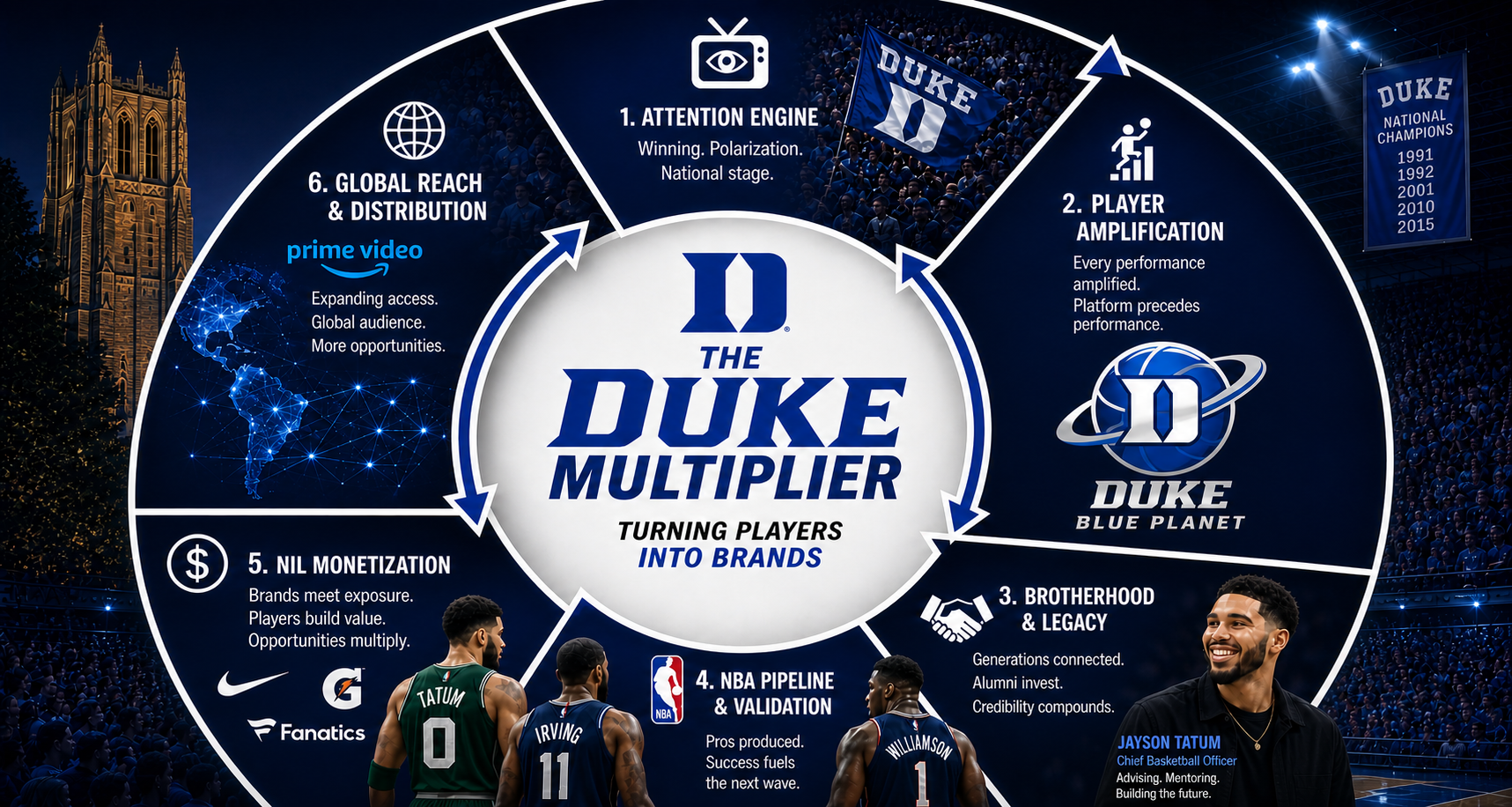
The Duke Multiplier: How Duke Turns Players Into Brands
In the NIL era, every program can offer money. Not every program can offer Duke Blue Devils men’s basketball. Because at Duke, the value isn’t just in the deal—it’s in the multiplier. For decades, Duke has built one of the most recognizable—and polarizing—brands in sports. In today’s landscape, that brand doesn’t sit alongside players; it elevates them. The result is something few programs can replicate: athletes who arrive as prospects and leave not only as pros but also as platforms, ripe and brand-ready. Duke didn’t stumble into this position—it engineered it. Under Mike Krzyzewski, sustained winning turned into something more valuable than banners: visibility. National championships, Final Four runs, and constant placement in marquee games made Duke appointment television. Over time, the audience expanded beyond fans—people tuned in not just to watch Duke win but to watch them lose. Love them or hate them, you watch them. That’s the foundation. That level of polarization is an advantage most programs never achieve. While others fight for attention, Duke commands it. It’s a ratings driver, a social media lightning rod, and a permanent fixture in national conversation. In the NIL era, attention is currency—and Duke doesn’t just generate it; it concentrates it.
That concentration shows up the moment players put on the jersey. Cooper Flagg didn’t just meet expectations at Duke; he expanded into a national figure because every performance was amplified. Cameron Boozer saw his valuation rise before production ever matched it—proof that platform can precede performance. And Zion Williamson provided the blueprint before NIL even existed, turning Duke exposure into ubiquity. He wasn’t just a star; he became a content engine.
A critical, often overlooked piece of that amplification is Duke Blue Planet. More than just a behind-the-scenes outlet, it functions as an in-house storytelling machine—producing documentary-style content, practice access, and player-focused features that humanize athletes while expanding their reach. In a landscape where content drives connection, Duke Blue Planet ensures that players aren’t just seen on game night—they’re known. It bridges the gap between performance and personality, turning moments into narratives and narratives into marketability. For recruits and current players alike, it’s built-in media infrastructure that most programs simply don’t have.
That amplification doesn’t reset year to year—it compounds. “The Brotherhood” connects eras, linking current players to established NBA stars like Jayson Tatum, who signed on to be Duke’s first-ever Chief Basketball Officer (CBO) in October 2025. Tatum serves as an advisor to Coach Jon Scheyer, providing insights on player development, mentoring of student-athletes, and advice on team culture and roster construction. That kind of continuity and alumni buy-in creates built-in credibility, sustained visibility, and an easy narrative for brands to buy into. It’s an engine that not only drives expansion of brands but is a recruiting edge as well.
Duke isn’t just selling individual players; it’s selling association with a lineage. That lineage scales at the next level. Duke’s presence doesn’t end in March—it expands in the National Basketball Association. Every success story at the professional level feeds back into the program, reinforcing credibility, strengthening recruiting appeal, and increasing NIL value for the next wave. There’s a difference between producing pros and producing brands—Duke consistently does the latter.
Now, that entire ecosystem is evolving again. Through its partnership with Amazon Prime Video, Duke is stepping into a new tier of exposure. This isn’t just about streaming games—it’s about redefining distribution. By placing marquee matchups on a global platform, Duke expands beyond traditional television into worldwide accessibility, opening the door for NIL integration and direct-to-consumer engagement. It transforms Duke from a team into something closer to a media property.
That shift matters because it strengthens the feedback loop that already separates the program. Winning creates attention. Attention builds brands. Brands carry into the NBA. NBA success feeds back into Duke. Now, streaming scales the entire system globally. The audience grows, the reach expands, and the monetization opportunities multiply.
Importantly, the brand holds because the culture supports it. Under Jon Scheyer, Duke has maintained a structure built on professionalism, media readiness, and consistency. Players don’t just gain attention—they’re equipped to handle it, which makes them more valuable in a market where visibility alone isn’t enough. And with platforms like Duke Blue Planet reinforcing that visibility daily, the exposure isn’t sporadic—it’s sustained and curated.
Other programs are chasing pieces of this model. Many can match spending, but they struggle to replicate the full equation: sustained attention, generational continuity, integrated media infrastructure, and now, forward-thinking distribution. That’s why Duke still separates. In today’s college basketball economy, there are three real currencies: money, attention, and distribution. Most programs have one. Some have two. Duke has all three.
Winning built the brand. Polarization sustained it. The NBA validated it. NIL monetized it. Duke Blue Planet amplified it. And now, streaming globalizes it.
That’s the Duke multiplier.