

As Duke Blue Devils men’s basketball continues building around versatility and positional size, Deron Rippey Jr. gives the Blue Devils something every elite roster still needs at its core: a guard who can bend a defense before the possession is even fully set. The emphasis for Jon Scheyer has been clear since he took over in Durham: surround talent with pace, pressure, and playmaking. That’s exactly where Rippey fits in.
And there’s another layer to his game that stands out immediately: Rippey plays like a New York City point guard.
That means toughness. Pace. Creativity. Confidence. NYC guards historically play with a certain edge—comfortable in chaos, unafraid of big moments, and wired to attack pressure instead of avoiding it. There’s a long tradition of New York guards playing with a blend of swagger and competitiveness, guards who take pride in controlling games, making difficult reads in tight spaces, and embracing physicality on both ends of the floor.
That influence shows up throughout Rippey’s game. He plays with confidence, but not recklessness. There’s rhythm to the way he attacks defenders, almost like he’s dictating the possession instead of reacting to it. He’s comfortable playing in traffic, comfortable making plays late in possessions, and comfortable carrying responsibility with the ball in his hands. Those are traits often sharpened in the New York basketball scene, where guards are expected to be creators, leaders, and competitors all at once.
Rippey arrives in Durham with the kind of downhill explosiveness that immediately changes the geometry of the floor. He’s not simply fast in the open court—he’s sudden in tight spaces. His ability to turn the corner off a ball screen forces defenders into recovery mode almost instantly, and once he gets a shoulder advantage, he has the balance and body control to stay on the attack. That’s a trait that translates early at the college level because it pressures defenses in ways schemes can’t always solve.
Deron Rippey Jr.
- PG
- 6’2, 175lbs
- Brooklyn, NY
A Guard Built to Pressure Defenses
What makes Rippey especially intriguing in Jon Scheyer’s system is that his game isn’t built around over-dribbling or hunting difficult shots. He plays with intent. When he attacks, it’s to collapse the defense, force rotation, and create an advantage for the entire possession. That’s where his playmaking becomes so valuable.
He has a natural feel for manipulating help defenders. When the low man commits, Rippey can fire the skip pass. When a big steps up, he’s comfortable dropping the ball off in traffic. When defenders go under screens, he has the confidence to rise into pull-ups or re-engage the action and force another rotation. There’s a patience to his game that separates him from guards who rely solely on athleticism.
That patience is another hallmark of high-level NYC guards. New York point guards have historically been taught to control tempo and command the floor, not simply race through possessions. Rippey flashes that understanding already. He changes gears naturally, keeps defenders off balance, and understands when to pressure the defense versus when to organize the offense.
And while much of the attention surrounding Rippey centers on his burst with the ball, his pace control may ultimately become one of his most important traits. He knows when to accelerate and when to let a possession breathe. Duke has increasingly emphasized quick decision-making and flow offense under Scheyer, and Rippey’s ability to keep the ball moving without losing attacking pressure fits naturally into that identity.
How Rippey Fits Into Duke’s Guard Core
What makes Rippey especially valuable this season is how his skill set complements the rest of Duke’s backcourt. Duke has size on the perimeter. It has scoring upside. It has wings capable of handling and creating. What Rippey provides is a true downhill initiator—someone who naturally pressures the paint and forces defenses to shift. That changes the dynamic for everyone around him.
His ability to collapse defenses should create cleaner looks for Duke’s shooters and more driving lanes for athletic wings operating off secondary actions. In many ways, Rippey gives the Blue Devils connective tissue offensively. He’s capable of organizing possessions while still applying constant pressure to opposing defenses.
There’s also lineup versatility in having a guard with his pace and creation ability. Duke can play bigger around him because he can handle primary initiation duties. It can also play faster because Rippey naturally pushes tempo and looks to create early offense before defenses are set.
And defensively, his energy at the point of attack fits the type of aggressive perimeter identity Scheyer has continued trying to build. With length behind him and switchable defenders across the floor, Rippey’s ability to pressure ball handlers could become an important trigger for Duke’s overall defensive activity.
Transition Play and Offensive Tempo
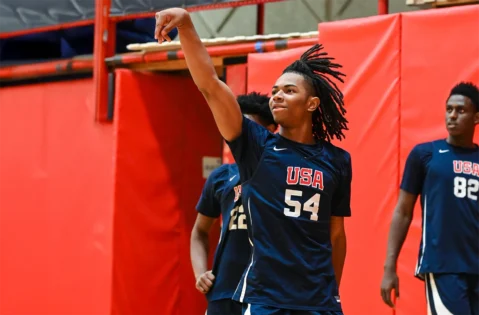 His transition game could become particularly impactful for the Blue Devils. Duke’s roster construction continues trending toward long, athletic wings capable of running the floor and finishing above the rim. Rippey thrives in those environments.
He pushes tempo aggressively, forces defenders to retreat, and creates easy offense before defenses can get organized. Even simple advance passes become dangerous when paired with his speed because defenders are constantly worried about him getting downhill himself.
More importantly, Rippey gives Duke a different tempo offensively. He has the ability to turn defensive rebounds into immediate offense and create possessions where opponents are scrambling before the half-court defense can even get set. That kind of pressure changes the rhythm of games.
There’s also a certain flair to the way he plays in the open floor. Not flashy for the sake of it, but confident and instinctive. That creativity feels very much in line with the tradition of guards who come out of New York basketball—players comfortable improvising in space while still keeping teammates involved.
Defensive Energy at the Point of Attack
There’s also a level of competitiveness to Rippey’s game that shows up defensively. He doesn’t just defend with quick hands—he plays with disruption in mind. He pressures ball handlers, looks to speed opposing guards up, and competes through possessions instead of conceding angles. Duke’s defensive ceiling is often tied to how much pressure its guards can apply at the point of attack, and Rippey has the tools to become a tone-setter there.
For a roster expected to feature length and switchability across multiple positions, having a guard capable of initiating pressure at the top of the defense only amplifies what the Blue Devils can become collectively.
Why His Skill Set Fits Modern Duke Basketball
 The physical tools stand out immediately, but his overall offensive versatility may be what ultimately raises his long-term ceiling. Rippey can create in ball-screen action, attack in space, operate in transition, and generate paint touches consistently. Those are foundational skills for modern lead guards, especially within an offense that prioritizes spacing and multiple creators.
Like most young guards entering high-major basketball, consistency will determine how quickly everything comes together. Improving perimeter efficiency, making quicker reads against elite defensive coverages, and limiting turnovers in traffic will all be part of his development curve. But the framework is already there for a highly impactful player because the hardest traits to find—burst, feel, creativity, and competitive edge—are already present.
The Bottom Line
More than anything, Rippey gives Duke an element of pressure. Defensive pressure. Rim pressure. Tempo pressure. The kind that forces opponents to spend entire possessions reacting instead of dictating. And for a Duke team looking to blend skill, athleticism, and versatility across the roster, that kind of lead guard can become the engine that makes everything else work.