
He arrived on a scooter. He left a legend. Now, the question isn’t whether Caleb Foster belongs but whether anyone’s paying enough attention.
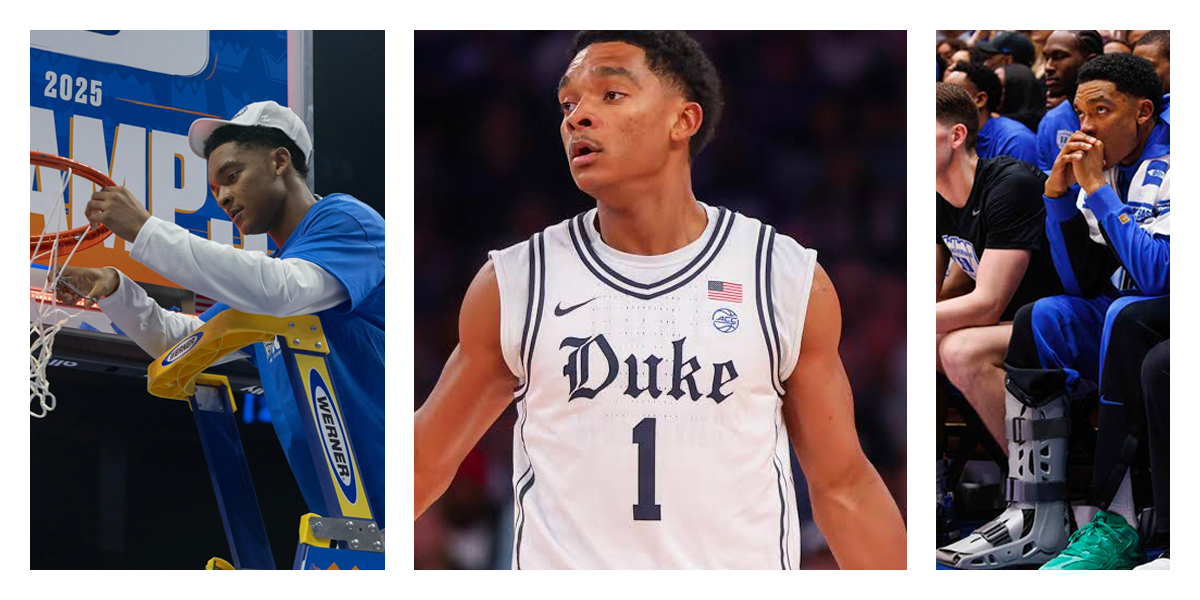
The doctors were clear and the surgery was done; the season, to anyone watching from the outside, was over. On March 7, 2026, Caleb Foster planted his right foot awkwardly in the first half of Duke’s rivalry game against North Carolina and turned immediately toward the bench. Imaging confirmed a fracture. Surgery followed the next morning. Jon Scheyer told reporters Foster would be out indefinitely, and privately, everyone understood what that meant. Duke would have to figure out March without him. But Foster had other plans.
The Return Nobody Saw Coming
By the time Duke faced St. John’s in the Sweet 16 in Washington, D.C., Foster had missed five games. The Blue Devils had won them all. They were rolling as the No. 1 overall seed, and they probably didn’t need Caleb Foster. Probably. The Red Storm brought their suffocating full-court press and knocked down nine first-half threes. They took a 40-39 lead at halftime, and then three turnovers in the opening minutes of the second half led to consecutive dunks from Big East Player of the Year Zuby Ejiofor. Suddenly Duke was down 55-44, and the game was slipping away. That’s when Foster checked in. He hadn’t played five-on-five basketball in nearly three weeks.
He arrived at the arena on a scooter. And yet there he was, running point in an elimination game on pure will. What followed was one of the more remarkable stretches in recent tournament history. He hit two layups, a seven-foot jumper, and a free throw – Duke’s next seven points – steadying an offense that had been flailing and neutralizing the press that had been devouring his teammates. He finished with 11 points, three rebounds, two assists, and zero turnovers in 19 minutes. Duke won 80-75 and advanced to the Elite Eight.
“Those plays saved our season,” associate head coach Chris Carrawell said.
“He had no business playing tonight,” Scheyer said afterward. “Ninety-nine percent of guys do not come back to play under the circumstances of what’s happened to him. There are no analytics. There’s no stats that can measure how big this dude’s heart is.”
Foster held his postgame press conference on the same scooter, foot wrapped in ice, and smiled.
Three Years of Building Something Real
That performance didn’t come out of nowhere. It was the product of a three-year college career defined as much by perseverance as production. Foster arrived at Duke as a consensus top-20 recruit in the class of 2023. His freshman year showed promise, averaging 7.7 points, 2.4 rebounds, and 2.1 assists per game before a right ankle stress fracture ended his season. His sophomore year was harder: 4.9 points in 14 minutes per game, buried in the rotation behind one-and-done phenoms. In the era of the transfer portal, where loyalty is rare and patience in short supply, Foster stayed. The junior season was the payoff.
Per Sports Reference, Foster averaged 8.5 points, 3.7 rebounds, and 2.5 assists across 26 regular-season games, shooting 45.1 percent from the field and 38.8 percent from three – all career bests. His true shooting percentage sat at 56.1, his assist-to-turnover ratio over the final six regular-season games was a remarkable 25-to-2, and his modest 17.8 percent usage rate meant he delivered that efficiency without even demanding the ball. He scored 20 points at Louisville, had 12 points and four assists in a road win over No. 1 Michigan, and was the engine Duke ran through quietly while bigger names grabbed the headlines. Then the foot gave out again.
Overlooked Again
When Foster announced his return for a senior season in late April, it deserved to be a big story. Instead, the conversation about Duke’s 2026-27 team was immediately dominated by other names. Wisconsin transfer John Blackwell – who averaged over 19 points per game with the Badgers – arrived as arguably the top guard in the transfer portal. Five-star recruit Cameron Williams headlines a top-two national recruiting class. Cayden Boozer is back. Dame Sarr is back. Patrick Ngongba II is back.
And Caleb Foster? Some analysts have already slotted him to come off the bench, calling him “the ultimate teammate” who “will fill any role Scheyer asks” – a polite way of suggesting he’ll fade quietly into the background. While those assertions are true, Foster embodies both of those statements; however, he is more than that – a lot more.
Duke’s Actual Secret Weapon
Start with what Duke is losing. Isaiah Evans, who averaged 15 points per game and was one of the program’s most electric shot-creators, is gone to the NBA Draft. The Blue Devils need someone who can stabilize possessions, manage the ball in high-pressure moments, and provide experienced point guard play when games get tight in March. That is Caleb Foster’s entire skill set, and the numbers back it up. A 45.1 field goal percentage and 56.1 true shooting percentage, achieved while serving as the primary facilitator for a No. 1 team.
A 25-to-2 assist-to-turnover ratio down the stretch. Nearly four rebounds per game from the point guard spot. These are the marks of a player doing real work, not filling a role.
Blackwell is a scorer, not a traditional point guard. Cayden Boozer is still developing. The freshmen are freshmen. Duke is going to need a veteran floor general who has been in high-stakes moments, and Foster – with 98 career games under his belt, fully healthy, and with something to prove – fits that bill in a way the offseason narrative has consistently undervalued. His 6-foot-5 frame gives him defensive versatility. His three-point shooting, consistently in the 38-39 percent range, forces defenses to respect him. And his leadership – the last standing member of his 2023 recruiting class, who chose Duke again and again when easier paths were available – is the kind that simply cannot be transferred in. One More Run There’s something almost poetic about where Foster finds himself. Three years of being the backbone without being the face.
Three years alongside Cooper Flagg, Cameron Boozer, and Isaiah Evans, doing the unglamorous work while others collected the magazine covers. Now he gets one final run, healthy and motivated, on a team built to go deep in March. The stars will get their moments – Blackwell will score, Boozer will run the show, and Williams will create highlights. But when games get tight in the tournament, when a team needs someone who has already been in that moment, those games come down to players like Caleb Foster.
The man who played through a broken foot on a scooter isn’t done yet. He’s just getting started.