
I keep hearing it. Over and over, like a record stuck on the same groove: “Keep politics out of sports.” Every time I hear it, I have to stop myself, because that sentence only makes sense if you’ve never had to fight for the right to play. If you’ve never been told that the field wasn’t yours. If your body simply existing on that field was never considered political. Let me be clear about where I’m coming from. I’m a Black man. I’ve spent my whole life watching sports—on the court, on the field, and everything that happens around them but I’ve also grown up in a country that only appreciates Black bodies for their entertainment value while devaluing their humanity and their rights. My perspective is my own, but dismissing that perspective is part of the problem. Too often, people reject what they don’t understand because comfortable myths are easier to live with than uncomfortable truths.
You Can’t Separate What Was Never Apart
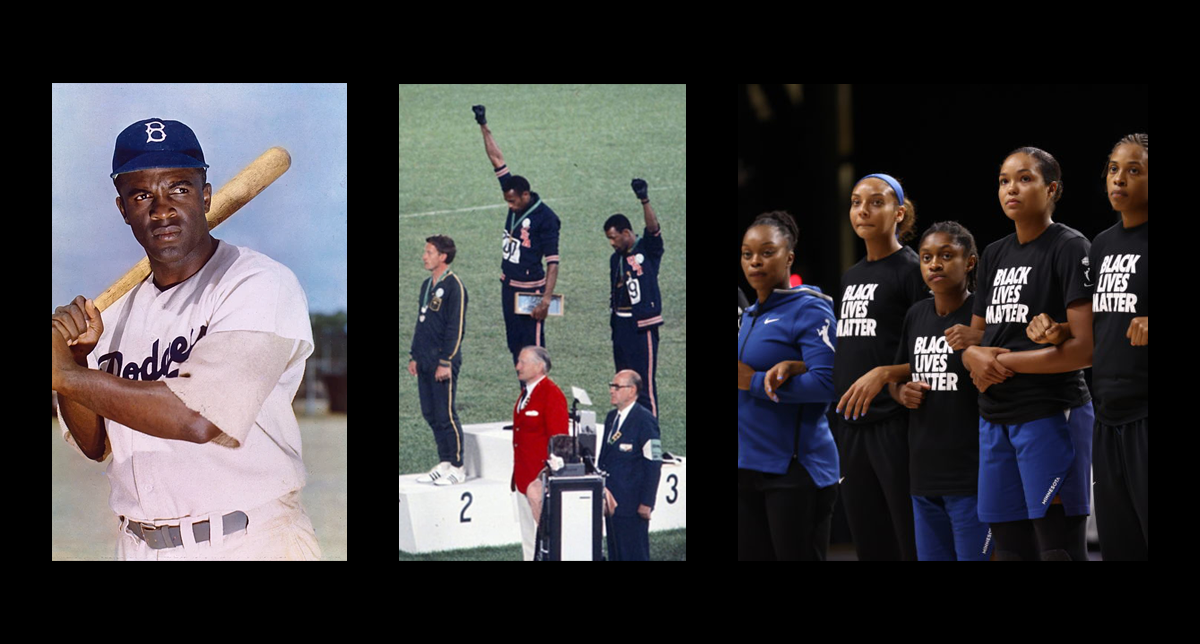
Sports, like music, art, or film, aren’t an escape from culture. They are culture. They’re one of the ways people celebrate, protest, endure, and make themselves heard when other doors are closed. Jackie Robinson didn’t just break baseball’s color barrier. He shattered the argument that segregation belonged in the game. Every day he stepped onto the field while death threats filled his mailbox, America had to wrestle with the contradiction of cheering for a man it still treated as less than equal. That wasn’t politics invading sports. It was politics exposed through sports. Politics isn’t just elections or political parties. It’s how a society decides who belongs, who has power, and whose voice matters. When Tommie Smith and John Carlos raised black-gloved fists on the Olympic podium in 1968, heads bowed during the national anthem, they weren’t trying to ruin the Games. They were forcing the world to look at something it wanted to ignore. The International Olympic Committee stripped them of their medals and sent them home in disgrace. What frightened people wasn’t the gesture itself. It was the visibility.
America has long been comfortable celebrating Black excellence as entertainment, even as a source of national pride. Accepting Black people as equals has always been a much harder conversation. That’s politics. That’s why it mattered then and why it still matters now. Muhammad Ali refused induction into the Vietnam draft and lost the heavyweight championship at the peak of his career. He sacrificed years he’ll never get back because he refused to fight for a country that denied him full citizenship at home. That wasn’t politics creeping into sports. For many athletes, sports have been the only microphone they’ve ever had. Sports may be your escape. For some of us, they’ve always been our access. The people who demand we “keep politics out of sports” usually say it loudest when Black athletes are speaking. They had no objection when military flyovers became part of the spectacle. No objection when patriotic ceremonies became fixtures before every game. No objection when leagues wrapped themselves in the flag. Apparently that wasn’t political. It only became “too political” once the people on the field started talking back.
The Ones Who Forgot Where the Road Came From
This is the part that hurts the most. The criticism from people who never understood us isn’t surprising. What’s harder to watch is the forgetting from within. Some Black athletes today—wealthy, celebrated, globally recognized—seem to believe success makes them untouchable. As if enough money can buy distance from Blackness, from struggle, or from the responsibility to acknowledge the people who made their success possible. They’re not necessarily bad people. But it’s a dangerous illusion. LeBron James once shared something his mother told him: “Money doesn’t change racism.” He’s lived that reality himself—from being told to “shut up and dribble” to finding the N-word spray-painted on the gate of his home in Bel-Air. Money bought him the house. It couldn’t stop someone from reminding him how they saw him. Every endorsement deal, every signature sneaker, every multimillion-dollar contract enjoyed by Black athletes today rests on a foundation somebody else built. It was built by athletes whose careers were cut short because they spoke when it wasn’t safe. By players who were blackballed. By pioneers who sacrificed opportunities the next generation would never have to think about. It was also built by Black women who spent decades fighting simply to be respected, paid fairly, and treated as professionals. Some of today’s athletes recognize that history and honor it. Others treat it like ancient history—as if it has nothing to do with them. Their success is absolutely the product of talent and relentless work. But it’s also the product of a movement they didn’t have to build. Forgetting that doesn’t erase the debt. It only proves how easy it is to benefit from history without remembering who made it possible.
Caitlin Clark, Sophie Cunningham, and the Politics We Pretend Aren’t Politics
I want to be clear here because clarity matters. Caitlin Clark is genuinely on her way to becoming a transcendent basketball talent. What she’s done for the visibility of the WNBA is important and should be recognized. But talent doesn’t protect you from criticism. The political views you share say something about how you see your teammates.
Sophie Cunningham is a different case. Her open support of MAGA politics, her stance on social media, and the company she keeps ideologically aren’t just personal choices. The MAGA movement has been openly and repeatedly hostile to Black Americans, immigrants, and LGBTQ+ individuals. These groups make up a significant portion of the WNBA’s players and fans. Choosing to publicly and proudly associate with that movement while profiting in a league focused on diversity and inclusion is not an act of neutrality. It’s a statement. When athletes in this space start getting too close to right-wing commentary known for its racist, xenophobic, and anti-LGBTQ ideology, the backlash they face isn’t an example of cancel culture. It’s accountability. The principle is simple: sports reflect culture, and culture has consequences. The Black women of the WNBA have fought for their league, their pay, their dignity, and their recognition long before any particular player became a media star. They deserve acknowledgment for that effort. They don’t have the luxury of viewing politics as an issue that belongs elsewhere. Their presence in this league and in this country has always been political. When Brittney Griner was detained in a Russian prison, the political response to her situation was clouded by layers of racism and homophobia, making it clear how long it took America to act. That’s no coincidence. This is what happens when politics invades the locker room, whether you want it there or not.
What I’m Actually Saying
I’m not asking athletes to become politicians. I’m asking them to be honest about the world they live in. I want those who have achieved true success—who have created generational wealth—to understand that their success doesn’t prove the system is fair. Instead, it shows they were extraordinary enough to meet a standard that was set deliberately high in a race where the starting blocks were moved. I’m asking those who have associated with movements that harm their teammates, their fans, and their community to take responsibility for that choice and its consequences. You can’t compete in a diverse, progressive league and then claim your political affiliations exist in a separate moral universe.
And I’m asking fans, commentators, and networks who keep saying “stay in your lane” to consider: whose lane is sports, really? Because from my view, it has always belonged to those who had no other options. Sports aren’t an escape from struggle. For many of us, it has always been the struggle.
Honesty in the Trans Athlete Conversation
There’s one more aspect of this culture war that I can’t ignore because it keeps entering the discussions we’ve been having. That’s the debate over transgender athletes. I’m no expert, nor do I have a complete perspective, but I genuinely care about people, their safety, and their right to exist and be heard. I want to be fair because fairness is essential. At the elite level, there are real, unresolved scientific questions about whether transgender women keep enough physiological advantage from male puberty to affect competition in certain sports. Researchers are still investigating this issue. Governing bodies are arriving at different conclusions. Those discussions deserve to take place seriously, with real science guiding them instead of fear and politics.
However, the policy debate in this country isn’t happening at the elite level. It’s happening in middle schools and high schools. That’s where the argument falls apart. Before puberty, there are no significant physiological differences among children that create the competitive advantage the opposition claims to be concerned about. Differences in muscle mass, bone density, and lung capacity develop during and after puberty. They don’t exist in a ten-year-old or a twelve-year-old. So when lawmakers seek to ban trans girls from youth sports, they aren’t ensuring fairness in competition. There’s no advantage to protect against. What they are doing is excluding children from a vital social and developmental experience of growing up, and it’s pointless and just for politics.
And here’s what I know for certain: the loudest voices using trans athletes as a political weapon are mainly the same voices that have shown little genuine concern for women’s sports. They don’t watch the WNBA. They didn’t support Title IX. They don’t advocate for pay equity, better facilities, or equal broadcast time for women athletes. They couldn’t name five WNBA players before Caitlin Clark made it hard to ignore them. Their concern about “protecting women’s sports” arose just when it became a convenient political tool. It mainly targets the kids for whom the science clearly shows there’s nothing to protect against.
We’re talking about kids who want to play with friends, build community, and feel a sense of belonging. The same movement that wraps itself in the language of fairness has almost nothing to say about the fairness of telling a thirteen-year-old she can’t be on the team—not because she has any demonstrated advantage, but because her existence makes some people uncomfortable. This connects directly back to everything we’ve discussed. The selective outrage about trans athletes, Black athletes speaking out, and “politics in sports” is never truly about what it claims to be about. It’s about who gets to take up space. Who gets to be visible. Who gets to compete, protest, exist, and be seen without having to justify their right to be there. The field was never just a field, the court was never just a court. Those who want you to believe otherwise have always had a reason for wanting you to remain silent about it.